Dialling a Belgian number from abroad seems simple: add +32 and drop the initial zero. Mistakes still happen because Belgian numbering combines geographic area codes of varying lengths, mobile prefixes reshuffled by number portability and, since late 2024, anti-spoofing filters that can block legitimate calls. This article covers the technical details that general guides tend to overlook.
Anti-spoofing filters in Belgium: impact on incoming and outgoing calls
Since 1 September 2024 for landline numbers and 1 December 2024 for mobile numbers, Belgian operators have been required to block certain calls from abroad that display a Belgian number. The measure targets CLI spoofing, a technique that lets callers fake their caller ID to impersonate a bank, government agency or someone you know.
The system does not cover SMS messages or calls displaying a foreign number. In other words, a call from France showing a +33 number passes through without being filtered. However, a French company using a Belgian geographic number hosted in the cloud (virtual switchboard, conference calling or outsourced customer service) may find its calls rejected if its operator has not registered this use with the regulator.
A complete guide to +32, Belgium’s country calling code explains how to dial a number before covering these filtering mechanisms.
Some legitimate uses of Belgian numbers from abroad, such as mobile telephony or conference bridges, may be exempt under certain conditions. Organisations using a SIP trunk with Belgian numbers should check with their operator that the relevant exemptions have been registered.
Call from a suspicious Belgian number: verify the caller’s identity without calling back
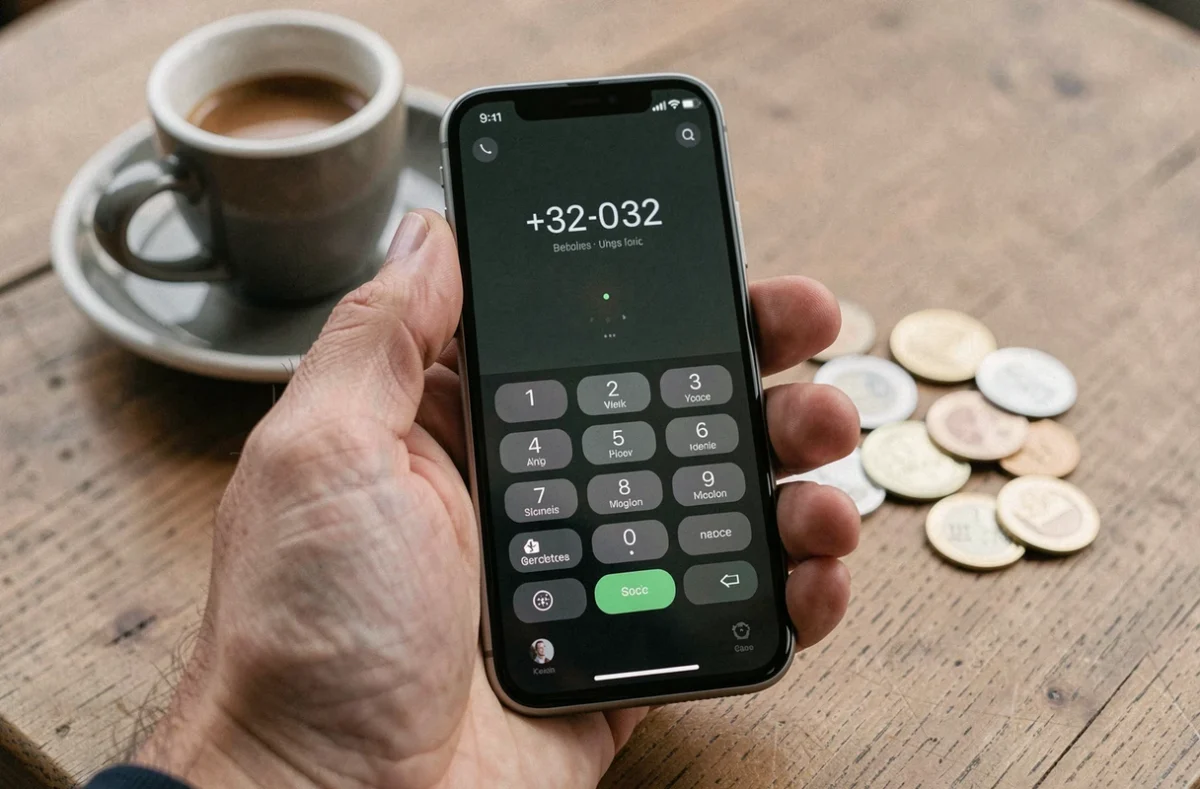
An incoming call displays a +32 number followed by a Brussels area code (2) or a mobile prefix (4xx). The caller claims to represent your bank, insurer or a Belgian public service and asks for sensitive information. Despite anti-spoofing filters, calls displaying a foreign number are not covered by the block, and some spoofing scenarios remain technically possible.
Practical steps to take when you receive a suspicious +32 call
- Never call back the number displayed. Look up the organisation’s official number on its website and dial it manually, using +32 followed by the area code without the zero.
- Ask for a case ID or reference number, then hang up and contact the organisation through a separate channel (official email or online account).
- Check the displayed prefix: a Belgian mobile prefix (047x, 048x, 049x) does not guarantee which operator currently serves the line, because number portability lets customers switch operators without changing their number. The prefix identifies the block originally assigned, not the operator currently serving the line.
No legitimate organisation will ask for a password, bank verification code or card number over the phone. This rule applies regardless of the caller ID displayed.
Dialling +32: the zero rule and variable-length pitfalls
The basic format remains the same: +32 (or 0032) followed by the Belgian number without its initial zero. A Brussels landline written as 02 345 67 89 in Belgium is dialled as +32 2 345 67 89 from France. A mobile number written as 0470 12 34 56 becomes +32 470 12 34 56.
The challenge lies in the varying lengths of area codes. Brussels uses a one-digit area code (2), as do Antwerp (3), Ghent (9) and Liège (4). Most other areas use two digits: Charleroi (71), Namur (81), Bruges (50) and Hasselt (11). The total number of digits in the number is between eight and nine, but the boundary between the area code and subscriber number varies.
Belgian geographic areas: a rough guide
Telephone areas do not match municipal boundaries. A geographic prefix covers several localities, sometimes extending beyond a province. The prefix indicates a numbering area, not the caller’s exact address. This helps businesses managing customer databases avoid inaccurate geographic assignments.
Belgian mobile prefixes and number portability: what the number no longer tells you
The three major legacy operators were originally assigned separate blocks of mobile prefixes: 047x for Proximus, 049x for Orange Belgium and 048x for Base (now Telenet). This original allocation no longer reflects the reality of the market.
With number portability, subscribers can keep their number when switching operators. A 0470 number may therefore be served by any Belgian operator or MVNO. Assuming you can identify the current operator from the prefix is a common mistake, particularly in call-routing tools and cloud telephony platforms that try to optimise costs based on the destination network.
For calls from France, charges depend on the caller’s plan, not the recipient’s Belgian operator. Most home broadband and phone packages include calls to Belgian landlines, while calls to Belgian mobiles are often charged outside the plan or included only in packages that cover Europe.
+32 is one of the easiest country codes to use from France, thanks to the shared time zone and the lack of any difference in calling hours. The two main things to watch out for are anti-spoofing filters for businesses using Belgian numbers from abroad, and always verifying the identity of callers who ask for sensitive information. Drop the zero, add +32 and check that the call is legitimate: these three steps cover almost every situation.